What is Pasteurization?
A process that uses heat to eliminate dangerous bacteria and microorganisms i.e., Pathogens from food and beverages is called pasteurization. This method was invented by Louis Pasteur in the 19th century.
It principally involves heating the product to a particular temperature for a predetermined time and then cooling it.
The process of pasteurization is also known to enhance preservation quality by almost eliminating target organisms/pathogens that cause spoilage. This procedure can help the product stay fresher for longer and make it safer to eat.
Within the dairy business, dairy pasteurizer has transformed the dynamics of food safety. For global and national food safety standards, it is obligatory to pasteurize required products, majorly those with high water content.
"Nearly all milk products on the market shelf today have undergone pasteurization."
The primary purpose of pasteurization is to remove any potential pathogenic organisms to render the product safe for human consumption and aid in maintaining a good flavor of the product for a longer time.
How Was Pasteurization Invented?
The pasteurization method was first created in the 19th century by a French scientist named Louis Pasteur. As part of Pasteur's broader examination into the origins of disease, which helped him comprehend the role of microbes in fermentation and decay, pasteurization was eventually developed.
French wine and beer spoiling was the focus of Pasteur's earliest research. This research revealed that bacteria were to blame for these spoilage issues. He invented the "pasteurization" procedure in 1862, which involved heating the liquids to about 55℃ (131℉) for a short period to kill the bacteria and stop spoiling.
Pasteur extended his studies into milk and other liquids in 1864, demonstrating that hazardous bacteria could be eliminated through pasteurization which also enhanced the safety and shelf life of these foods. He provided evidence that pasteurization can effectively stop illness and epidemics brought on by tainted milk, including then-common anthrax and tuberculosis.
Pasteurization was swiftly embraced by many businesses, particularly the dairy industry, as a reliable method of halting the spread of illness and enhancing the safety of food and beverages. To ensure their safety and lengthen their shelf lives, pasteurization is now frequently used to prepare a variety of foods and beverages, including milk, juice, and even beer and wine.
How Does Pasteurization Work?
Food or liquid is pasteurized by being heated to a specified temperature for a predetermined amount of time, and then quickly cooled. While maintaining the product's nutritional content and flavor, this technique eliminates dangerous germs and microbes that might lead to food-borne illness or spoilage.
Franz von Soxhlet, a German chemist, advocated pasteurizing milk in 1886, while Louis Pasteur himself experimented with wine. A public health official in the United States named Milton Rosenau, set guidelines for low-temperature pasteurization by 1912, prescribing moderate heating at 60℃ (140℉) for 20 minutes.
The physiochemical nature of pasteurized food determines the pasteurization periods and temperatures. However, milk is heated to 135℃ during UHT pasteurization (ultra-high-temperature) for only two to five seconds.
Nearly all of the bacterial spores that exist in dairy products are killed by this brief exposure to intense heat. Ultra-pasteurized refers to the heat treatment that UHT gives to dairy products. Several brands of organic milk are included in this.
The type of product being pasteurized, the target shelf life, and the safety criteria all affect the method and temperature that are employed. Although pasteurization does not make the product sterile, rather it limits the number of bacteria that could contaminate or sicken consumers.
It is vital to understand that pasteurization simply limits the bacteria present and makes the product safe for consumption; it does not add any chemicals to the product or change its nutritional content. To avoid contamination and maintain the product's safety, it is also essential to treat pasteurized items carefully following the defined procedure.
Also read, Difference between Pasteurization and Sterilization
What Are the Benefits of Pasteurization?
Pasteurization provides several advantages that make it a crucial component of many food processing companies. These benefits and advantages include:
Consistently Improved Food Safety and Quality
Pasteurization helps to get rid of dangerous germs like Listeria, Salmonella, Listeria, Staphylococcus aureus, Yersinia, Campylobacter, and Escherichia coli from milk and other food products, and help lower the chance of contracting foodborne illness.
It also helps in avoiding illnesses including diphtheria, TB, brucellosis, and scarlet fever.
More Shelf-Stable Products
By reducing the growth of microorganisms that might lead to spoilage and contamination, pasteurization can also aid to prolong the shelf life of food products.
Food products' nutritious content is preserved for a longer time via pasteurization, which can be done at lower temperatures than other sterilization techniques.
Cost-effective
Pasteurization is a generally quick and inexpensive process as compared to other techniques, which can help food companies cut expenses while maintaining the quality of their products.
Greater Alignment with Regulations
The International and National Standards of Food Safety suggest employing pasteurization as a preservation technique and including it as a prerequisite for ensuring the safety of the consumers.
Hence, pasteurization will help food processors and manufacturers align better with food quality and safety standards.
Flavor and Texture Enhancements
In some circumstances, pasteurization can enhance the flavor and texture of your product. Foods may frequently contain bacteria that, over time, cause disagreeable odors without necessarily lowering the quality of the product. By getting rid of such microorganisms, customers may continually have a good experience with the product.
Commonly Pasteurized Products
Pasteurization may be applied to both packaged and unpackaged solids and liquids.
Here are
some most common and essential foods that require pasteurization:
Juice and Beverages
After juice extraction, the main pasteurization is carried out as quickly as feasible at 95-98℃ for 10 to 30 seconds. The primary goal of pasteurization in juices is to deactivate the fruit's enzymes and also deactivate the fruit's bacteria. Enzyme inactivation typically necessitates more rigorous pasteurization procedures than are necessary to kill bacteria.
Dairy Products (Milk, Cheese, Butter, Ice cream, Yogurt, Cream)
Products made from milk and cream that have been pasteurized are meant for direct consumer usage. Whole milk, skim milk, homogenized milk, and several forms of cream are included in this category of goods.
High-Temperature Short Time (HTST) pasteurization to a minimum of 161℉ for no less than 15 seconds, followed by rapid cooling, is the most popular technique for pasteurizing dairy products.
Frozen Desserts
Pasteurization is required for frozen milk products including ice cream, gelato, frozen custard, and frozen yogurt.
High pasteurization occurs when the ice cream mixture is rapidly heated to 78 to 85℃ and allowed to stabilize for around 5 to 20 seconds. After that, it is cooled to 4℃ and put into maturation tanks for storage. Average pasteurization involves rapidly raising the ice cream mixture's temperature to 72℃ and stabilizing it there for 10 to 15 seconds.
Other food products and beverages that need pasteurization are:
- Alcoholic and fermented beverages (beer, wine, cider, kombucha)
- Eggs and egg products
- Imitation meats and deli meat
- Nuts (almonds, peanuts)
- Flour and its products (bread, cereal, etc.)
Types/Methods of Pasteurization
High Temperature, Short Time (HTST) Pasteurization
To eliminate any hazardous bacteria present, milk is heated to a high temperature (generally between 161℉ and 165℉) for a brief amount of time (about 15-20 seconds). This process is known as high-temperature short-time (HTST) pasteurization. This procedure makes the liquid safe to drink while retaining its flavor and nutritional content. This is the most widely used method in the dairy business with dairy pasteurizers.
High-Temperature Short-Time (HTST) pasteurization is most commonly used for liquid products, such as Milk, Juice, Wine, Beer, etc.
Ultra High Temperature (UHT) Pasteurization
For UHT pasteurization (ultra-high-temperature), the food product must be heated to 138–150℃ (280–302℉) for two or four seconds. UHT pasteurization milk that has been packaged in sterile, hermetically sealed containers can be kept without refrigeration for months at a time. Despite being packaged with less severe standards, ultra-pasteurized milk and cream must be kept in the refrigerator because they must be heated to at least 110-120℃ for at least two seconds.
Vat Pasteurization
Vat pasteurization, also known as batch or low-temperature long-time pasteurization, involves the vat jacket heating the product to a temperature of 62–64℃, holding it at this temperature for roughly 30 minutes, and then the vat jacket cooling it. In a refrigerator, pasteurized products have a shelf life of one to three weeks depending on the product, process, and packing.
Vat pasteurization is largely used in the dairy sector to prepare milk for use in the production of cheese, yogurt, etc.
Gain Technology Edge over Your Competition with Neologic Engineer's Pasteurizer
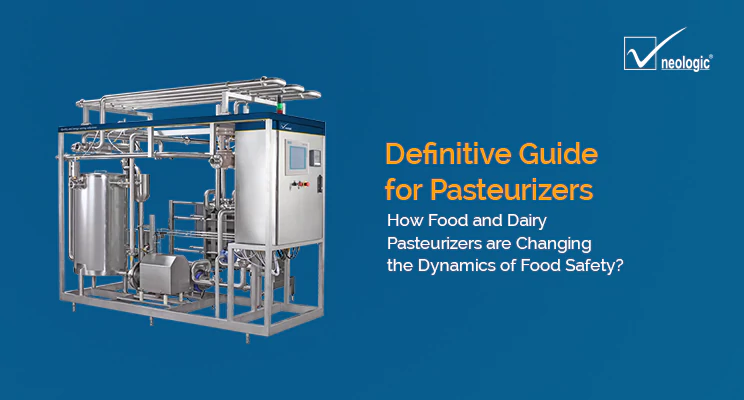
To get the right results from pasteurization getting the right food and dairy pasteurizers is essential. Food and dairy pasteurizers designed by Neologic Engineers, the most trusted food and milk pasteurizers manufacturers have best-in-class features.
Neologic Engineers is one of its kind milk and food pasteurizer manufacturers that provides a regeneration efficiency of up to 93%.
You can gain a competitive edge with the Future proof design of Neologic Engineers dairy pasteurizers having the advantages of:
- Supervisory password-supported PLC and Conventional PID-based control systems.
- Fully modular design with SS skid-mounted installation and start-up.
- Hot water system with a special expansion chamber in Tubular Hot Water Heat Exchangers.
- Food and dairy pasteurizers come in various capacities of 1000 LPH to 50,000 LPH with precise temperature control within +/-0.5℃.
What Is the Difference Between Milk Pasteurization and Milk Homogenization?
Pasteurization is a technique that includes heating milk to a high temperature for a limited amount of time (15–20 seconds), often between 161–165℉ or 72–74℃, to eliminate any potentially hazardous bacteria.
Whereas, milk's texture can be improved by the homogenization process. It functions by breaking down the milk's fat globules into very small sizes so that they are uniformly dispersed throughout the liquid rather than forming cream at the top. Under intense pressure, the milk is forced through tiny apertures in this process. Milk becomes more constant as a result, and it is less likely to separate when it is stored.
In conclusion, homogenization is a technique that breaks down the fat particles in milk to give the milk a more consistent texture and delays creaming, while pasteurization is a process that destroys hazardous bacteria in milk.
Read more, Difference Between Milk Pasteurization and Milk HomogenizationTable of Content
- What is Pasteurization?
- How Was Pasteurization Invented?
- How Does Pasteurization Work?
- What Are the Benefits of Pasteurization?
- Commonly Pasteurized Products
- Types/Methods of Pasteurization
- Gain Technology Edge over Your Competition with Neologic Engineer's Pasteurizer
- What is the Difference Between Milk Pasteurization and Milk Homogenization?