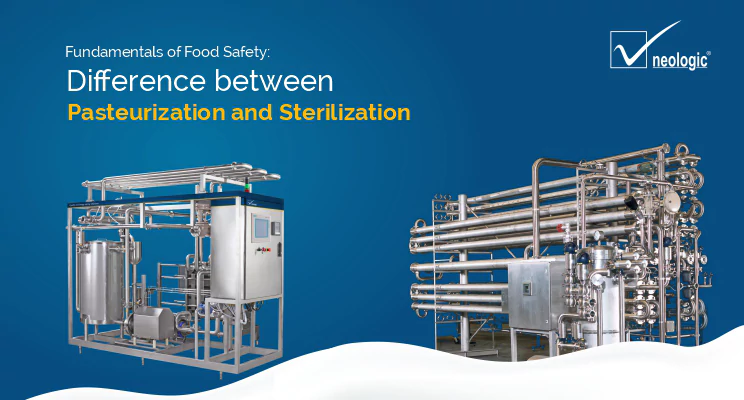
Fundamentals of Food Safety: Difference between Pasteurization and Sterilization
Pasteurization and Sterilization are two critical steps that form the basis of food safety in the entire food industry. These heat treatment procedures each serve a different purpose in maintaining the safety and quality of different food products.
In this blog, we will discuss,
- The terminology
- Key differences between Pasteurization and Sterilization
- General industrial applications
- Science behind Pasteurization and Sterilization
- Equipment employed in each process
Pasteurization is a heat treatment procedure that involves heating food or beverages to a specified temperature for a predetermined amount of time to destroy or minimize pathogenic germs. It aims to establish a balance between safety and preserving the product's flavour, nutritional content, and some beneficial bacteria.
Sterilization, on the other hand, is a more intense heat treatment at higher temperatures above 100 ° C to eliminate all microorganisms from the product, including pathogens, bacteria, viruses, and spores. It creates a fully sterile environment, preventing growth of food spoiling bacteria and other micro-organisms and thereby prevent spoilage of food.
What are the key differences between Pasteurization and Sterilization?
Objective:
- Pasteurization: To ensure food safety by killing certain pathogenic germs while maintaining product quality.
- Sterilization: Complete sterility is achieved by eliminating all types of micro-organisms.
Destruction by Microbes:
- Pasteurization: Reduces microbial load by exposing food or beverages to higher temperatures for a set period, targeting pathogens while leaving certain beneficial microorganisms alone.
- Sterilization: Intensive heat treatment at higher temperatures over an extended period is used to ensure the removal of all living microorganisms, including pathogens, bacteria, viruses, and spores.
Shelf Life:
- Pasteurization: Increases shelf life by deactivating spoilage-causing microbes and preserving product quality for a longer period. All bacteria is not killed, hence post this heat treatment the food has to storage and distributed in cold chain (refrigerated conditions)
- Sterilization: Brings a longer shelf life by deactivating (killing) all the food spoiling bacteria, micro-organisms and preventing them from causing deterioration and preserving product safety & stability. Post this heat treatment, the food is packed aseptically, thereby enabling the storage and distribution of food without refrigeration (cold chain).
General Industry Applications:
- Pasteurization:
- Dairy industry: Milk, cheese, yoghurt, and other dairy products.
- Beverage industry: Fruit juices, beer, wine, and non-alcoholic drinks.
- Food processing: Soups, sauces, and certain packaged foods.
- Sterilization:
- Canning industry: Canned foods, including vegetables, fruits, and meats.
- Dairy & Beverage Industry: Market Milk, Fermented Milk products, Juices and Drinks
- Pharmaceutical industry: Sterilization of medical equipment, drugs, and surgical instruments.
- Laboratory Equipment: Sterilizing media, equipment, and labware.
Equipment Used:
- Pasteurization:
- Pasteurization vats or tanks
- Heat exchangers (e.g., plate heat exchangers, tubular heat exchangers)
- Sterilization:
- Heat exchangers (e.g., tubular heat exchangers, plate heat exchangers)
- Autoclaves or retorts
- Pressure cookers
- Sterilization chambers or tunnels
How does Pasteurization Work?
Pasteurization is based on the killing action of heat on microbes. Pasteurization, which involves subjecting food or beverages to regulated heat treatment, seeks to remove or minimize pathogenic bacteria while keeping product quality. Specific temperature and time limits are used to achieve a balance between safety and the protection of flavour, nutritional content, and beneficial microorganisms.
The application of heat during pasteurization affects the structure and function of microorganisms. Heat induces denaturation of proteins, enzymes, and nucleic acids in pathogens, resulting in deactivation or death. The exact temperature and time combination used during pasteurization is determined by the product being treated. This helps to ensure that undesirable germs are destroyed while limiting the influence on sensory qualities and nutritional content.
Also read, Definitive Guide for Pasteurizers
How does Sterilization Work?
Sterilization is a more severe heat treatment method than pasteurization, to thoroughly eliminate all bacteria. The principle of sterilization is based on the point that different types of germs have varying degrees of heat resistance.
The product is sterilized by exposing it to intense heat for an extended period of time. Heat is used to eliminate microorganisms such as bacteria, viruses, spores, and other illnesses. The higher temperature changes the cellular structure of bacteria, causing irreversible damage to critical components like proteins, enzymes, and genetic material.
The temperature and time of sterilization are determined by the tolerance of the most heat-resistant bacteria of concern. The goal is to remove the even most resilient microbiological forms, such as bacterial spores, resulting in a sterile product.
The science underlying pasteurization and sterilization is based on understanding the heat sensitivity of various microorganisms and applying heat treatment to achieve the desired level of germ reduction or removal while retaining product quality and safety.
Types of Pasteurization
Vat Pasteurization or Low Temperature
In a vat pasteurizer, a temperature-controlled, closed vat is employed. The food product is treated for around 30 minutes at 62°C to 64°C before being immediately chilled.
Short Time/High Temperature (HTST)
Often known as flash pasteurization or the continuous method, refers to high-temperature, short-time processing. It is now one of the most often-used pasteurization processes. The liquid is heated for 15 to 30 seconds at temperatures ranging from 71.5°C to 74°C or from 74°C to 76°C for 15 to 20 seconds, then rapidly cooled to between 4°C and 5.5 °C using a continuous heat exchanger.
Types of Sterilization
Ultra-High-Temperature (UHT) Sterilization for Juices and Drinks
It involves exposing the product to a high temperature for a brief amount of time, which is also known as flash sterilization or continuous sterilization. Temperatures above 100°C are used for a few seconds to a few minutes. It is frequently used for liquids including juices, soups, and sauces.
Ultra-High-Temperature (UHT) Sterilization for Milk
The product is heated to temperatures exceeding 135°C (typically between 135 and 145°C) for a few seconds. UHT sterilization enables aseptic packing, ensuring that the product remains sterile until opened. This process is most typically used for dairy products including milk, cream, and yogurt.
Retort Sterilization
Packaged food is placed in specialized containers such as cans, jars, or pouches and exposed to high temperatures and pressures in a retort chamber. The product is heated to temperatures ranging from 115°C to 135°C for a defined period of time. Retort sterilization is commonly used in the manufacture of canned foods like vegetables, fruits, meats, and ready-to-eat meals.
Irradiation
The food product is exposed to ionizing radiation, most typically gamma rays, X-rays, or electron beams. Because the radiation damages their DNA or biological structures, microorganisms are unable to grow or reproduce. It is used to preserve a variety of goods such as spices, herbs, dried fruits, and meat.
Neologic Engineers is a leading innovator of food processing solutions for pasteurization and sterilizing procedures. We provide cutting-edge technology and equipment to assure the safety and quality of food items using their vast experience in engineering and automation.
As a trusted Pasteurization machine manufacturer, We specialize in the design and implementation of customized pasteurization systems that efficiently reduce or eliminate harmful bacteria while preserving the sensory and nutritional value of the food.